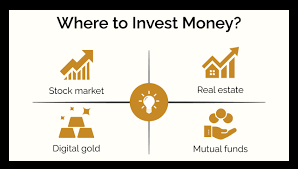
Few of the most well-liked asset classes
|
Table of Contents : The Need Of Investment 2. Where Should I Put My Money? 3. Few of the most well-liked asset classes 4. Asset Allocation - dividing up a budget among different asset types |
Fixed Income Securities
Fixed income Securities are investment vehicles wherein the money you invest, or your main amount, is thought to be secure. On the principal you invest, the entity pays interest. The most basic type of fixed investment instrument is the bank's fixed deposit plan. Interest may be paid on a quarterly, semi-annual, or annual basis. At the conclusion of the investment period, sometimes referred to as the maturity period, the investor receives their capital back.
Here are some examples of fixed-income securities:
Fixed Deposits at Banks, Government of India bonds, commonly referred to as G Sec bonds and T Bills.
Bonds issued by government-affiliated companies like NHAI, HUDCO, GAIL, etc.
Bonds from corporations (Adani, Tata, Bajaj, Reliance).
Because the government cannot steal your money and run away with it, government bonds are thought to be the safest investment option. However, investing in corporate bonds carries risk; there have been many instances in the past where this has happened.
Equity
Purchasing shares of companies that are publicly traded is known as investing in equity or stocks. Both the National Stock Exchange (NSE) and the Bombay Stock Exchange (BSE) are venues for trading the shares.
There is no capital guarantee when an investor invests in equities, in contrast to fixed-income securities. On the other hand, investing in stocks can yield substantially higher returns as a trade-off. Indian stocks have had a compound annual growth rate (CAGR) of over 12% throughout the previous ten to fifteen years.
Long-term returns on investments made in some of the best and most professionally managed Indian companies have exceeded 20% CAGR. It takes talent, diligence, and perseverance to spot these kinds of financial opportunities.
Real Estate
Commercial and non-commercial land transactions are a part of real estate investment. Transactions in commercial buildings, residences, and unoccupied plots are typical examples.Real estate investments yield two types of income: capital appreciation on the initial investment and rental income. I don't think the rental yield is all that appealing because it usually ranges between 2 and 3 percent. The increase in land prices is not consistent and only occurs in some areas.
The legal verification of documents involved in the transaction process might make it fairly complex. Investing in real estate typically requires a substantial financial commitment. The returns that real estate generates are not quantified by any formal statistic. Therefore, it would be difficult to comment on this.
Commodity – Bullion
Silver and gold are regarded as some of the most well-liked investment possibilities. In the long run, gold and silver have gained value. Over the past 20 years, investments in these metals have produced a CAGR return of roughly 5-8%. Purchasing gold and silver may be done in a number of ways. Investment options include jewellery, Exchange Traded Funds (ETFs), and Sovereign Gold Bonds, or SGBs as they are more commonly known.
- If one had invested in quality corporate bonds with fixed income at an annual average rate of 9%, the corpus would have increased to Rs. 3.3Crs.
- If one had invested in stocks at a 15% annual average, the corpus would have increased to Rs. 5.4Crs.
- If bullion investments were made at an average annual rate of 8%, the corpus would have increased to Rs. 3.09Crs.