Bull Call Spread Strategy: A Complete Guide for Traders
1) Introduction
Options trading is often seen as complex, but strategies like the bull call spread simplify decision-making for traders who expect moderate upward movement in a stock or index. Unlike outright call buying, which exposes you to higher costs and unlimited risk of premium loss, the bull call spread balances risk and reward by combining two call positions. This article explores the bull call spread in detail—its mechanics, payoff structure, strike selection, advantages, disadvantages, and practical applications—so you can confidently use it in your trading journey.
2) What is a Bull Call Spread?
A bull call spread is a two-leg options strategy designed for traders with a moderately bullish outlook. It involves:
- Buying one call option at a lower strike price (usually at-the-money or slightly in-the-money).
- Selling one call option at a higher strike price (out-of-the-money).
Both options must:
- Belong to the same underlying asset.
- Share the same expiry date.
- Be executed in equal quantities.
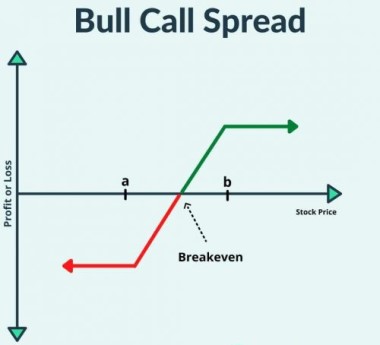
This structure reduces the upfront premium cost compared to buying a single call, while capping both the maximum profit and maximum loss.
3) Why Use a Bull Call Spread?
Traders often face situations where they expect a stock or index to rise, but not aggressively. For example:
- Fundamental triggers: Earnings announcements that are expected to be positive but already partially priced in.
- Technical setups: A stock bouncing from long-term support but still in a broader downtrend.
- Quantitative signals: Mean reversion after a sharp decline without fundamental justification.
In such cases, buying a plain call may be too expensive, while selling naked options may be too risky. The bull call spread offers a middle ground.
4) Mechanics of the Strategy
Let’s break down the mechanics with a hypothetical example:
Underlying asset: Nifty 50 at 18,000.
Buy leg: 18,000 call option at ₹200 premium.
Sell leg: 18,200 call option at ₹120 premium.
Net Debit
The cost of the strategy = Premium paid – Premium received = 200 – 120 = ₹80.
This ₹80 is the maximum loss possible.
Maximum Profit
The spread between strikes = 18,200 – 18,000 = 200.
Maximum profit = Spread – Net Debit = 200 – 80 = ₹120.
Breakeven Point
Breakeven = Lower strike + Net Debit = 18,000 + 80 = 18,080.
If the market closes above 18,080, the strategy becomes profitable.
5) Payoff Scenarios
Market closes below 18,000: Both options expire worthless. Loss = Net Debit = ₹80.
Market closes at 18,080: The long call gains ₹80 intrinsic value, offsetting the debit. Net P&L = 0.
Market closes at 18,200: Long call gains ₹200, short call expires worthless. Net profit = ₹120.
Market closes above 18,200: Long call gains more, but short call loses equivalently. Net profit capped at ₹120.
6) Advantages of Bull Call Spread
- Lower cost: Premium outlay is reduced compared to buying a naked call.
- Defined risk: Maximum loss is limited to the net debit.
- Defined reward: Maximum profit is capped, avoiding unrealistic expectations.
- Flexibility: Can be tailored with different strike combinations based on volatility and time to expiry.
7) Disadvantages
- Capped profit: You cannot benefit from unlimited upside.
- Complexity: Requires understanding of option Greeks, especially theta and delta.
- Margin requirements: Though reduced compared to naked selling, margin is still needed for the short leg.
8) Strike Selection
Choosing the right strikes is crucial. Consider:
Volatility:
- High volatility → choose closer strikes (ATM + OTM).
- Low volatility → slightly wider strikes may work.
Time to expiry:
- Early in the series → far OTM strikes may be profitable.
- Near expiry → ATM strikes are safer due to theta decay.
Expected move: Quantify “moderate” based on historical volatility. For indices, a 3–5% move is often considered moderate.
9) Role of Option Greeks
- Delta: Measures sensitivity to price changes. The long leg has higher delta than the short leg, ensuring net bullish exposure.
- Theta: Time decay affects both legs. The short leg offsets some decay of the long leg.
- Vega: Volatility changes impact premiums. Since both legs are involved, vega exposure is reduced compared to naked calls.
10) Practical Applications
- Earnings trades: When results are expected to be positive but not explosive.
- Relief rallies: Stocks bouncing from oversold conditions.
- Range-bound markets: When indices are expected to move moderately within defined ranges.
11) Comparison with Other Strategies
- Naked Call Buying: Higher cost, unlimited upside, unlimited premium risk.
- Covered Call: Requires owning the underlying, less flexible.
- Bull Put Spread: Similar payoff but uses puts instead of calls, often with different margin implications.
12) Risk Management
- Always calculate breakeven before entering.
- Avoid illiquid strikes with wide bid-ask spreads.
- Monitor margin requirements, especially near expiry.
- Exit early if the outlook changes drastically.
13) Example with Realistic Numbers
Suppose Reliance Industries trades at ₹2,500.
- Buy 2,500 CE at ₹60.
- Sell 2,600 CE at ₹30.
Net Debit = ₹30.
Max Profit = (2,600 – 2,500) – 30 = ₹70.
Breakeven = 2,530.
If Reliance closes at 2,600 or higher, profit = ₹70. If it closes below 2,500, loss = ₹30.
14) Psychological Benefits
- Peace of mind: Loss is capped.
- Realistic expectations: Profit is predefined.
- Confidence: Balanced exposure reduces fear of sudden volatility.
15) Advanced Variations
- Ratio Bull Call Spread: Buying more calls than selling, increasing upside potential but adding risk.
- Diagonal Bull Call Spread: Using different expiries to balance theta decay.
- Synthetic Bull Call Spread: Combining futures and options for similar payoff.
Conclusion
The bull call spread is a versatile, cost-effective strategy for traders with a moderately bullish outlook. It reduces premium costs, defines risk and reward, and suits a variety of market conditions. While profits are capped, the trade-off is worthwhile for those seeking controlled exposure. Mastering strike selection, understanding option Greeks, and practicing disciplined risk management are key to success with this strategy.