Introduction
Candlestick charts are more than just colorful visuals on a trading screen — they are windows into market psychology. Each candle tells a story about the battle between buyers and sellers. Among the many formations, single candlestick patterns are particularly powerful because they can signal reversals or continuations with just one candle.
In this article, we’ll explore three of the most important single candlestick patterns: the Hammer, the Hanging Man, and the Shooting Star. These patterns are widely used by traders to identify potential turning points in the market. We’ll break down their structure, psychology, trading strategies, advantages, and limitations, giving you a complete guide to using them effectively.
What Are Single Candlestick Patterns?
Definition: A single candlestick pattern is formed from one trading session’s price action.
Components: Each candle reflects the open, high, low, and close (OHLC).
Interpretation:
- Long shadows = strong rejection of price levels.
- Small bodies = indecision or weak conviction.
- Large bodies = strong momentum in one direction.
These patterns are simple yet powerful when combined with broader technical analysis.
The Hammer Candlestick
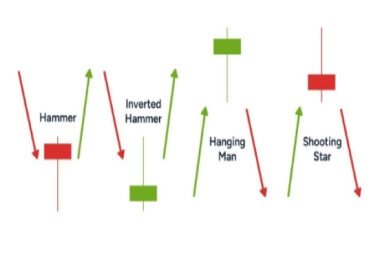
The Hammer is a bullish reversal pattern that appears after a downtrend. It has a small body at the top of the trading range and a long lower shadow.
Key Features
- Small real body near the high of the session.
- Lower shadow at least twice the length of the body.
- Upper shadow is minimal or absent.
Market Psychology
- Sellers push prices lower during the session.
- Buyers step in aggressively, driving the price back up near the high.
- The long lower shadow shows rejection of lower levels, signaling potential reversal.
Trading Strategy
- Entry: Buy near the close of the hammer or on the next bullish candle.
- Stop-Loss: Place below the low of the hammer.
- Confirmation: Stronger if followed by a bullish candle or volume spike.
The Hanging Man Candlestick
The Hanging Man looks similar to the hammer but appears after an uptrend. It is a bearish reversal signal.
Key Features
- Small body near the top of the range.
- Long lower shadow, at least twice the body length.
- Upper shadow is minimal.
Market Psychology
- Bulls are in control during the uptrend.
- Sellers enter the market, pushing prices lower intraday.
- Buyers recover, but the long lower shadow shows that selling pressure is emerging.
- Signals potential weakness in the uptrend.
Trading Strategy
- Entry: Short near the close of the hanging man or after a bearish confirmation candle.
- Stop-Loss: Place above the high of the hanging man.
- Confirmation: Stronger if followed by a red candle or increased selling volume.
The Shooting Star Candlestick
The Shooting Star is a bearish reversal pattern that appears after an uptrend. It looks like an inverted hammer.
Key Features
- Small body near the low of the session.
- Long upper shadow, at least twice the body length.
- Lower shadow is minimal or absent.
Market Psychology
- Buyers push prices higher, creating a long upper shadow.
- Sellers step in strongly, driving the price back down near the low.
- The long upper shadow shows rejection of higher levels, signaling bearish sentiment.
Trading Strategy
- Entry: Short near the close of the shooting star or after bearish confirmation.
- Stop-Loss: Place above the high of the shooting star.
- Confirmation: Stronger if followed by a red candle or volume increase.
Comparing Hammer, Hanging Man & Shooting Star
| Pattern | Trend Context | Signal Type | Shadow Direction | Sentiment |
|---|---|---|---|---|
| Hammer | Downtrend | Bullish | Long lower | Buyers rejecting lows |
| Hanging Man | Uptrend | Bearish | Long lower | Sellers entering market |
| Shooting Star | Uptrend | Bearish | Long upper | Sellers rejecting highs |
Advantages of These Patterns
- Easy to identify visually.
- Provide clear stop-loss levels.
- Work across multiple timeframes (daily, weekly, intraday).
- Useful for spotting reversals early.
Limitations
- Require confirmation from subsequent candles.
- Do not provide profit targets.
- Can produce false signals in volatile markets.
- Should not be traded in isolation — combine with support/resistance, trendlines, or indicators.
Practical Examples
Hammer in Downtrend: A stock falls steadily, forms a hammer at ₹444, and rallies. Traders buy with stop-loss at ₹441.
Hanging Man in Uptrend: A stock rallies to ₹593, prints a hanging man, and declines. Traders short with stop-loss at ₹594.
Shooting Star in Uptrend: A stock rises to ₹1453, forms a shooting star, and falls. Traders short with stop-loss at ₹1453.
Key Takeaways
- Hammer = bullish reversal after downtrend.
- Hanging Man = bearish reversal after uptrend.
- Shooting Star = bearish reversal after uptrend.
- Always use stop-loss at the extreme of the candle.
- Wait for confirmation before entering trades.
- Combine with other analysis tools for reliability.