Morning Star and Evening Star Candlestick Patterns with Gap Analysis
Introduction
Candlestick charts are more than just colorful bars on a trading screen—they are visual stories of market psychology. Among the most respected multi-candle formations are the Morning Star and Evening Star patterns. These setups are widely used to identify reversals at the end of strong trends.
But here’s the catch: both patterns rely heavily on gaps—price openings that occur above or below the previous day’s close. Without understanding gap behavior, traders risk misinterpreting these signals. This article explores Morning and Evening Stars in detail, with a special focus on gap up and gap down openings, their psychology, and how traders can use them effectively.
1. What Are Gaps in Trading?
A gap occurs when a security opens at a price significantly different from its previous close, leaving empty space on the chart.
- Gap Up Opening: The market opens higher than the prior close. This reflects strong buying enthusiasm, often triggered by positive news, earnings, or sentiment.
- Gap Down Opening: The market opens lower than the prior close. This reflects selling pressure, often caused by negative news or panic.
Gaps are critical in star patterns because they magnify the emotional shift between buyers and sellers. They show urgency—buyers rushing in at higher prices or sellers dumping at lower ones.
2. The Morning Star Pattern
Formation
The Morning Star is a bullish reversal pattern that unfolds over three sessions:
- P1: A long bearish candle, confirming sellers’ dominance.
- P2: A small candle (doji or spinning top) that opens with a gap down, signaling hesitation.
- P3: A strong bullish candle that opens with a gap up and closes above P1’s open, confirming reversal.
Market Psychology
- Day 1: Bears are in control, driving prices lower.
- Day 2: The market opens with a gap down, reinforcing bearish sentiment. But instead of continuing downward, the candle stalls, forming a doji or spinning top. This indecision rattles sellers.
- Day 3: Buyers return aggressively, opening with a gap up. The bullish candle erases losses from P1, signaling that momentum has shifted.
Trading Strategy
- Entry: Buy near the close of P3 or wait for confirmation on P4.
- Stop Loss: Place at the lowest low of the three candles.
- Target: Resistance zones or Fibonacci retracements.
3. The Evening Star Pattern
Formation
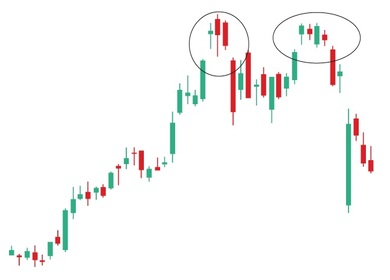
The Evening Star is a bearish reversal pattern that unfolds over three sessions:
- P1: A long bullish candle, showing buyers in control.
- P2: A small candle (doji or spinning top) that opens with a gap up, signaling hesitation.
- P3: A strong bearish candle that opens with a gap down and closes below P1’s open, confirming reversal.
Market Psychology
- Day 1: Bulls dominate, pushing prices higher.
- Day 2: The market opens with a gap up, reinforcing optimism. But instead of continuing upward, the candle stalls, forming a doji or spinning top. This hesitation worries buyers.
- Day 3: Sellers seize control, opening with a gap down. The bearish candle erases gains from P1, signaling panic among bulls and strength for bears.
Trading Strategy
- Entry: Short near the close of P3 or wait for confirmation on P4.
- Stop Loss: Place at the highest high of the three candles.
- Target: Support zones or moving averages.
4. Why Gaps Matter in Star Patterns
Without gaps, Morning and Evening Stars lose much of their reliability. The gaps highlight urgency:
- In a Morning Star, the gap down on P2 shows bears pressing hard, while the gap up on P3 shows buyers reclaiming control.
- In an Evening Star, the gap up on P2 shows bulls pushing aggressively, while the gap down on P3 shows sellers overwhelming them.
These gaps amplify the emotional swing from dominance to hesitation to reversal.
5. Variations of Star Patterns
- Doji Star: When P2 is a doji, the reversal signal is stronger.
- Flexible Gaps: While textbook definitions require gaps, traders sometimes accept patterns without perfect gaps if the psychology is clear.
6. Risk Management
- Always use stop losses at the extreme points of the pattern.
- Avoid trading star patterns in sideways markets.
- Confirm signals with indicators like RSI, MACD, or moving averages.
7. Common Mistakes
- Ignoring gaps when identifying star patterns.
- Misidentifying P2 when it’s not truly small or indecisive.
- Trading without confirmation from other indicators.
8. Advanced Tips
- Backtest star patterns with gaps on historical charts.
- Use them with support/resistance zones for higher accuracy.
- Watch for star patterns near psychological levels (round numbers).
Conclusion
The Morning Star and Evening Star candlestick patterns are powerful reversal signals, but their strength lies in the gaps. Gap up and gap down openings magnify the emotional transition from dominance to hesitation to reversal. By mastering these patterns and combining them with risk management and supporting indicators, traders can significantly improve their decision-making.
Remember, no pattern guarantees success. The Morning Star and Evening Star simply tilt probabilities in your favor. With practice, patience, and discipline, they can become essential tools in your trading arsenal.