Pivot Points in Trading: What They Are, Why They Work, and How to Build a Winning Strategy
In trading, price rarely moves randomly. It reacts to levels.
Some levels behave like floors where price stops falling. Others act like ceilings where rallies stall. These reaction zones repeat because millions of traders are watching them — and one of the most widely used tools for identifying such levels is Pivot Points.
Originally developed by floor traders, Pivot Points were a way to forecast probable support and resistance levels using only the previous session’s data.
Today, they are still heavily used by:
- day traders and scalpers
- professional trading desks
- algorithmic systems
- futures and forex traders
Pivot Points give fixed, pre-calculated trading levels — allowing traders to plan in advance instead of reacting emotionally.
What You Will Learn
- What Pivot Points are
- Why they work
- How to calculate them
- Different types of Pivot Points
- Trading strategies
- Common mistakes to avoid
- Risk-management rules
What Are Pivot Points?
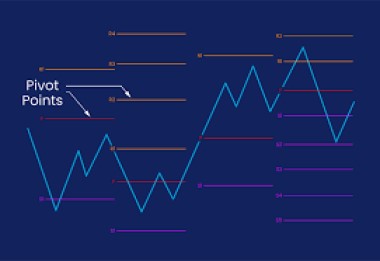
Pivot Points are mathematical price levels calculated from the previous period’s High, Low, and Close. From those values, we derive:
- Central Pivot (P)
- Support levels (S1, S2, S3…)
- Resistance levels (R1, R2, R3…)
These levels act as potential turning points during the next trading session.
Think of Pivot Points like a roadmap — giving probable reaction areas before the market opens.
Unlike moving averages, Pivot Points do not repaint, stay fixed all day, and allow traders to plan stops and targets ahead of time.
Why Do Pivot Points Work?
Pivot Points work because of market psychology:
- Thousands of traders watch the same levels
- Institutions program algorithms around them
- Reactions increase when price reaches them
The result is frequent bounces, pauses, or breakouts at Pivot Zones.
Standard Pivot Point Formulas
Central Pivot (P)
P = (High + Low + Close) / 3
Resistance Levels
R1 = (2 × P) − Low
R2 = P + (High − Low)
R3 = High + 2(P − Low)
Support Levels
S1 = (2 × P) − High
S2 = P − (High − Low)
S3 = Low − 2(High − P)
These formulas work on daily, weekly, or monthly charts — though intraday traders typically use daily pivots.
Different Types of Pivot Points
Different pivot systems exist for different market conditions. Below is the complete breakdown.
Traditional Pivot Points
Original floor-trader method. Assumes price rotates around the central pivot.
Best For: intraday trading, normal volatility.
Strength: simple and widely used.
Weakness: outer levels can be far during quiet markets.
Fibonacci Pivot Points
Combines pivot logic with Fibonacci ratios.
Range = High − Low
Resistance
R1 = P + 0.382 × Range
R2 = P + 0.618 × Range
R3 = P + 1.000 × Range
Support
S1 = P − 0.382 × Range
S2 = P − 0.618 × Range
S3 = P − 1.000 × Range
Best For: trending markets.
Weakness: noisy in sideways conditions.
Woodie’s Pivot Points
Gives more weight to the closing price.
P = (High + Low + 2 × Close) / 4
Best For: markets with gaps and indices.
Weakness: can distort after abnormal close spikes.
Camarilla Pivot Points
Designed for mean-reversion. Produces tight levels — great for scalping.
Traders often:
- buy near S3/S4
- sell near R3/R4
- target a return to pivot or VWAP
Weakness: risky in strong trends.
DeMark Pivot Points
Changes formulas based on whether the session closed bullish or bearish.
X = adjusted value
- If Close < Open → X = High + (2 × Low) + Close
- If Close > Open → X = (2 × High) + Low + Close
- If Close = Open → X = High + Low + (2 × Close)
Pivot = X / 4
Support = (X / 2) − High
Resistance = (X / 2) − Low
Best For: breakout bias.
Central Pivot Range (CPR)
Used heavily by professional intraday traders.
P = (High + Low + Close) / 3
BC = (High + Low) / 2
TC = (2 × P) − BC
Narrow CPR → trending day likely
Wide CPR → sideways market likely
How Traders Use Pivot Points
Pivot Points can be used to:
- identify reversal zones
- spot breakout levels
- determine bullish or bearish bias
They work best combined with:
- VWAP
- moving averages
- volume
- price action
Trading Strategies With Pivot Points
Strategy 1: Support–Resistance Bounce
Tools: Pivot Points + RSI
Buy Setup
- Price near S1 or Pivot
- Bullish reversal candle
- RSI oversold
Targets: Pivot → R1
Stop: below S1
Short Setup
- Price tests R1 or Pivot
- Bearish rejection
- RSI overbought
Targets: Pivot → S1
Stop: above R1
Strategy 2: Breakout and Retest
Long: Break above R1 → retest → buy → target R2.
Short: Break below S1 → retest → sell → target S2.
Strategy 3: CPR Trend Strategy
- Narrow CPR = trade breakouts
- Wide CPR = trade ranges
Common Mistakes
- Trading every touch blindly
- Ignoring trend direction
- Over-leveraging
- Skipping stop-loss
- Trading during news
Risk-Management Rules
- Risk only 1–2% per trade
- Always use stop-loss
- Avoid revenge trading
- Trade only valid setups
- Keep a trading journal
Final Thoughts
Pivot Points help traders anticipate where price might bounce, stall, or break. Combined with price action, VWAP, moving averages, and disciplined risk management, they form a powerful trading framework.
Start simple:
- add Pivot Points
- mark P, S1, S2, R1, R2
- wait for confirmation
Over time, patterns will become obvious — and trading becomes clearer and more structured.
FAQ
Do Pivot Points work in forex and crypto?
Yes — they work in any liquid market.
Which Pivot system is best?
Traditional works great for most traders. Add CPR or Fibonacci for refinement.
© Pivot Points Trading Guide — Educational Content Only