Introduction
Candlestick charts are the backbone of modern technical analysis. They provide traders with a visual snapshot of market psychology, capturing the battle between buyers and sellers in each trading session. Among the many candlestick formations, single candlestick patterns are particularly powerful because they can signal strong sentiment shifts with just one candle.
One of the most influential single candlestick patterns is the Marubozu. This pattern, simple in appearance yet rich in meaning, often marks decisive moves in the market. In this article, we’ll explore the Marubozu in detail, covering its types, psychology, trading strategies, risk management, and practical applications. By the end, you’ll understand how to use this pattern effectively in your trading journey.
What Are Single Candlestick Patterns
Definition: A single candlestick pattern is formed from one trading session’s price action.
Components: Each candle reflects the open, high, low, and close (OHLC) values.
Interpretation:
- Long candles = strong conviction (either bullish or bearish).
- Short candles = indecision or weak trading activity.
Unlike multi-candle formations, single candlestick patterns are straightforward but can still provide actionable insights when combined with broader market context.
The Marubozu Pattern Explained
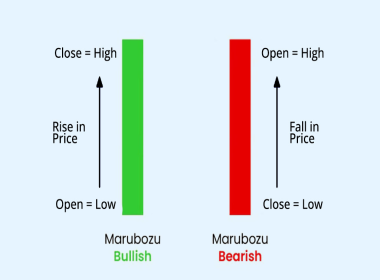
The term Marubozu comes from Japanese, meaning “bald.” The candle is called bald because it lacks upper and lower shadows — it’s just a solid body. This unique structure indicates that price moved strongly in one direction throughout the session.
Types of Marubozu
Bullish Marubozu
- Open = Low
- Close = High
- Represents strong buying pressure.
- Suggests that buyers dominated the session, pushing prices upward without resistance.
Bearish Marubozu
- Open = High
- Close = Low
- Reflects strong selling pressure.
- Indicates that sellers controlled the market, driving prices down consistently.
Market Psychology Behind Marubozu
Every candlestick tells a story of market sentiment. The Marubozu is particularly revealing:
Bullish Marubozu: Buyers are confident, purchasing at every level. Sellers are weak or absent. The close near the high signals optimism and potential continuation of the uptrend.
Bearish Marubozu: Sellers dominate, offloading positions at every price point. Buyers fail to defend higher levels, leading to a close near the low. This signals pessimism and potential continuation of the downtrend.
Unlike many patterns, the Marubozu does not require a prior trend to be valid. It can appear in any part of the chart and still carry weight.
Trading Strategies Using Marubozu
1. Entry Points
- Bullish Marubozu: Traders often buy near the closing price of the candle.
- Bearish Marubozu: Traders initiate short positions around the closing price.
2. Stop-Loss Placement
- In bullish setups, the low of the Marubozu acts as the stop-loss.
- In bearish setups, the high of the Marubozu serves as the stop-loss.
This built-in mechanism makes the pattern practical for risk management.
3. Risk Profiles
- Aggressive traders: Enter positions on the same day once the Marubozu is confirmed.
- Conservative traders: Wait until the next session to ensure the trend continues before entering.
The Trade Trap: Candle Length Matters
- Too short (<1% range): Indicates weak activity, unreliable signals.
- Too long (>10% range): Stop-loss placement becomes difficult, leading to higher risk.
- Ideal range: Moderate candles that balance conviction with manageable risk.
Advantages of Trading Marubozu
- Clear signals with minimal ambiguity.
- Built-in stop-loss levels.
- Works across multiple timeframes (daily, weekly, intraday).
- Effective for both beginners and experienced traders.
Limitations and Risks
- Marubozu does not provide profit targets. Traders must use other tools (support/resistance, moving averages, Fibonacci levels) to set exit points.
- False signals can occur, especially in volatile markets.
- Requires confirmation from subsequent price action for safer trades.
Key Takeaways
- Marubozu is a single candlestick pattern with no shadows, representing strong sentiment.
- Bullish Marubozu = buyers in control, look for long opportunities.
- Bearish Marubozu = sellers dominate, look for short opportunities.
- Always use the low/high of the candle as stop-loss.
- Avoid trading extremely short or long candles.
- Combine Marubozu with other technical tools for better accuracy.