Stock Market Chart Types Explained: Line, Bar, and Candlestick
Introduction
When traders look at the stock market, they need a way to understand how prices move. Every trading day has four key data points: open, high, low, and close (OHLC). A good chart should show all of these clearly. Without proper charts, analyzing months or years of data becomes confusing.
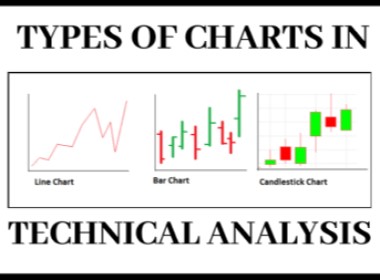
This article explains the three main chart types used in trading — line charts, bar charts, and candlestick charts — along with their advantages, disadvantages, and practical applications.
Why Regular Charts Don’t Work for Trading
Charts like pie charts or area charts are useful in business presentations, but they don’t help traders. That’s because they show only one data point at a time. In trading, you need to see all four OHLC values together.
The only exception is the line chart, which uses closing prices. While simple, it doesn’t give the full picture. That’s why traders prefer bar charts and candlestick charts.
Line Chart: Simple but Limited
A line chart connects closing prices over time.
- How it’s made: Each closing price is marked with a dot, and the dots are joined with a line.
- Timeframes: Can be plotted daily, weekly, monthly, or even hourly.
- Strength: Easy to read, shows the overall trend quickly.
- Weakness: Ignores open, high, and low prices.
Example
If you plot 60 days of closing prices, you’ll see the general direction of the stock. But you won’t know how volatile it was during the day.

Bar Chart: More Detail, Less Visual Appeal
A bar chart shows all four OHLC values.
Structure
- Vertical line = price range (high to low).
- Left tick = opening price.
- Right tick = closing price.
Color coding
- If close > open → bullish (often shown in blue/green).
- If close < open → bearish (often shown in red).
Range: The length of the bar shows volatility.
Advantages
- Displays all four price points.
- Helps identify bullish or bearish days.
Disadvantages
- Harder to spot patterns visually.
- Becomes complex when analyzing multiple charts.

Candlestick Chart: The Trader’s Favorite
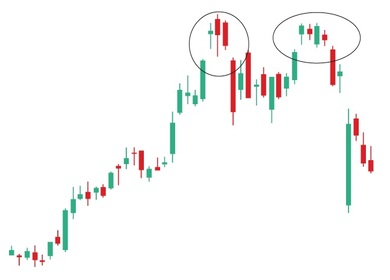
Candlestick charts are the most popular among traders. They originated in Japan in the 18th century, used by rice merchant Homma Munehisa. In the 1980s, Steve Nison introduced them to the Western world.
Anatomy of a Candlestick
- Body: Rectangular area showing open and close.
- Upper shadow: Line from body to high.
- Lower shadow: Line from body to low.
Color
- Bullish candle (close > open) → usually green/blue.
- Bearish candle (close < open) → usually red.
Why Traders Prefer Candlesticks
- Easier to interpret than bar charts.
- Quickly shows market sentiment.
- Patterns like Doji, Hammer, and Engulfing provide signals.
- Strong bodies = strong buying/selling; short bodies = weak activity.

Timeframes in Charting
Charts can be customized to different timeframes:
- Monthly: 12 candles per year.
- Weekly: 52 candles per year.
- Daily (EOD): One candle per trading day (~252 per year).
Intraday
- 30-minute → ~12 candles per day.
- 15-minute → ~25 candles per day.
- 5-minute → ~75 candles per day.
Choosing the Right Timeframe
- Long-term investors: Weekly or monthly charts (less noise).
- Swing traders: Daily or 15-minute charts.
- Intraday traders: 5-minute or 1-minute charts.
Noise vs Information
Not all data is useful. Shorter timeframes create more candles, which can be “noise.” Traders must filter out irrelevant moves and focus on meaningful signals.
- Noise: Random fluctuations that don’t affect the bigger trend.
- Information: Price moves that indicate real buying or selling pressure.
Example
A long-term investor should ignore 1-minute charts. They add noise without helping investment decisions.
Key Takeaways
- Line charts show trends but lack detail.
- Bar charts display OHLC but are visually complex.
- Candlestick charts are the most effective, showing sentiment and patterns.
- Timeframes matter — longer frames reduce noise, shorter frames suit active traders.
- Successful traders learn to separate noise from useful information.
Conclusion
Charts are the language of traders. While line charts are simple, they miss important details. Bar charts add more information but lack clarity. Candlestick charts strike the perfect balance, offering both detail and visual appeal.