Synthetic Long Strategies and Arbitrage in Options Trading
Introduction
Financial markets thrive on innovation, and derivatives are among the most versatile instruments available to traders. Options, in particular, allow market participants to replicate, hedge, and speculate with remarkable flexibility. One of the most fascinating applications of options is the creation of a synthetic long position, which mirrors the payoff of a long futures contract. Closely tied to this is the concept of arbitrage, where traders exploit price discrepancies across instruments or markets to lock in risk-free profits.
This article explores synthetic long strategies in detail, explains how they replicate futures payoffs, and demonstrates how arbitrage opportunities arise from pricing inefficiencies. By the end, you’ll understand not only the mechanics but also the practical scenarios where these strategies can be applied.
1. Understanding Futures and Their Payoff
Before diving into synthetic positions, it’s essential to revisit the basics of futures contracts. A futures contract obligates the buyer to purchase, and the seller to deliver, an asset at a predetermined price on a future date.
- Linear Payoff: Futures are called linear instruments because gains and losses move proportionally with the underlying asset.
- Breakeven Point: The entry price of the futures contract becomes the breakeven. Any upward movement generates profit, while downward movement results in loss.
- Symmetry: A 10-point gain equals a 10-point loss in the opposite direction.
This linearity makes futures straightforward but also exposes traders to unlimited risk. Options, however, can replicate this payoff with more flexibility.
2. Constructing a Synthetic Long Position
A synthetic long is created using options to mimic the payoff of a long futures contract. The construction is simple:
- Buy an At-The-Money (ATM) Call Option
- Sell an At-The-Money (ATM) Put Option
Both options must:
- Belong to the same underlying asset
- Share the same expiry date
Example
Suppose the Nifty index is trading at 7400.
- Buy the 7400 Call Option at ₹107
- Sell the 7400 Put Option at ₹80
The net cash outflow = ₹107 – ₹80 = ₹27.
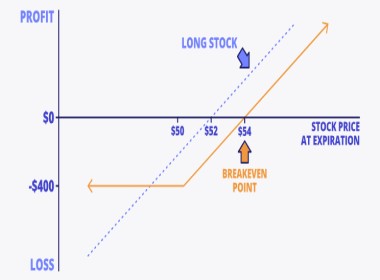
This combination replicates the futures payoff, with the breakeven point adjusted by the net premium difference.
3. Payoff Scenarios of Synthetic Long
Let’s analyze how the synthetic long behaves under different expiry levels:
- Market at 7200 (below strike):
Call expires worthless → loss of ₹107
Put has intrinsic value of ₹200 → net loss after premium = ₹120
Total loss = ₹227 - Market at 7400 (ATM):
Both options expire worthless
Net loss = ₹27 (initial premium outflow) - Market at 7427 (breakeven):
Call intrinsic value = ₹27, offset by premium
Put expires worthless
Net payoff = 0 - Market at 7600 (above strike):
Call intrinsic value = ₹200 – ₹107 = ₹93
Put expires worthless, retain ₹80
Total profit = ₹173
This demonstrates that the synthetic long behaves almost identically to a futures contract, with symmetric payoffs around the breakeven.
4. Why Use Synthetic Long Instead of Futures?
While futures are direct, synthetic longs offer advantages:
- Flexibility: Traders can adjust exposure using option premiums.
- Margin Efficiency: Sometimes margin requirements for options differ from futures.
- Strategic Hedging: Synthetic positions can be combined with other option strategies for complex hedges.
- Arbitrage Opportunities: Pricing mismatches between options and futures can be exploited.
5. Arbitrage Explained Through a Simple Analogy
Arbitrage is the practice of profiting from price differences across markets. Imagine a fish market:
- In City A, fish costs ₹100/kg.
- In City B, the same fish sells for ₹150/kg.
- Transport costs ₹20/kg.
Buying in City A and selling in City B yields a net profit of ₹30/kg. This is arbitrage—risk-free profit as long as supply, demand, and costs remain stable.
However, risks exist:
- Opportunity Risk: No fish available.
- Liquidity Risk: No buyers in City B.
- Execution Risk: Prices fluctuate during trade.
- Transaction Costs: Rising transport costs reduce profitability.
- Competition: More traders enter, reducing margins.
This analogy mirrors financial markets, where arbitrage opportunities vanish as competition increases.
6. Options Arbitrage and Put-Call Parity
In options trading, arbitrage opportunities often stem from Put-Call Parity, a fundamental relationship between calls, puts, and futures.
The equation:
Long Synthetic Long + Short Futures = 0
Expanded:
Long ATM Call + Short ATM Put + Short Futures = 0
If this equation doesn’t balance, an arbitrage opportunity exists.
Example
Nifty Spot = 7304
Nifty Futures = 7316
7300 Call = ₹79.5
7300 Put = ₹73.85
Positions:
- Long 7300 Call @ ₹79.5
- Short 7300 Put @ ₹73.85
- Short Nifty Futures @ 7316
Across different expiry scenarios, the net payoff consistently yields +10.35 points. This non-zero result indicates arbitrage.
7. Practical Considerations in Arbitrage
While arbitrage seems risk-free, transaction costs matter:
- Brokerage Fees: High fees can erode profits. Discount brokers improve viability.
- Taxes: Securities Transaction Tax (STT), service tax, and stamp duty reduce margins.
- Execution Timing: Positions must often be squared off before expiry to avoid heavy STT.
Thus, arbitrage is profitable only when the payoff exceeds transaction costs.
8. Key Takeaways
- Options can replicate futures payoffs through synthetic positions.
- A synthetic long is created by buying an ATM call and selling an ATM put.
- The breakeven point = Strike Price + Net Premium Paid.
- Arbitrage arises when synthetic long + short futures yields non-zero payoff.
- Transaction costs determine whether arbitrage is worth executing.
Conclusion
Synthetic long strategies showcase the versatility of options, allowing traders to replicate futures without directly entering futures contracts. Arbitrage opportunities, though rare and fleeting, highlight the importance of market efficiency. For traders, mastering these concepts provides a deeper understanding of derivatives and equips them to identify profitable opportunities when they arise.
By combining theoretical knowledge with practical awareness of costs and risks, traders can harness synthetic longs and arbitrage to enhance their trading toolkit.