Understanding Gamma in Options Trading: A Complete Guide
Options trading is often described as a world of probabilities, sensitivities, and mathematical relationships. Among the many concepts that traders encounter, Gamma stands out as one of the most important yet misunderstood. While Delta is widely discussed as the first derivative of an option’s premium, Gamma represents the second derivative — the rate at which Delta itself changes. To truly grasp Gamma, one must step beyond the basics of Delta and explore how option prices respond dynamically to movements in the underlying asset.
This article provides a comprehensive, SEO-friendly explanation of Gamma, its role in options trading, practical applications, and risk management strategies. Unlike many technical resources that dive straight into formulas, we’ll build understanding step by step, using analogies, examples, and trading scenarios. By the end, you’ll see why Gamma is crucial for professional traders and how it can influence both profits and risks.
1. Revisiting Delta: The Foundation
Before we can understand Gamma, let’s briefly revisit Delta. Delta measures how much the price of an option changes when the underlying asset moves by one unit. For example:
A call option with a Delta of 0.5 will increase by ₹0.50 if the underlying stock rises by ₹1.
A put option with a Delta of –0.4 will decrease by ₹0.40 if the underlying stock rises by ₹1.
Delta is not static. It changes as the underlying price moves closer to or further from the strike price. This variability is where Gamma comes into play.
2. What Is Gamma?
Gamma measures the rate of change of Delta with respect to the underlying asset’s price. In calculus terms:
Γ = d(Δ) / d(Underlying Price)
In simpler words, Gamma tells us how sensitive Delta is. If Delta is like the speed of a car, Gamma is the acceleration — it shows how quickly that speed changes when you press the pedal.
3. Why Gamma Matters
Gamma is critical because:
- It determines how fast an option’s Delta changes.
- It helps traders anticipate how option premiums will behave during sharp market moves.
- It highlights risk exposure, especially for option sellers who face unlimited losses.
For example, if you hold an at-the-money call option with a Delta of 0.5 and Gamma of 0.05, a ₹1 increase in the underlying will push Delta to 0.55. Another ₹1 increase will push Delta to 0.60, and so on. This compounding effect makes Gamma powerful.
4. Gamma and Moneyness
Gamma is highest for at-the-money options and decreases as options move deep in-the-money or far out-of-the-money. Why?
- At-the-money options are most sensitive to small changes in the underlying.
- Deep ITM options already behave almost like the underlying asset, so Delta is near 1 and changes little.
- Deep OTM options have Deltas near 0, so changes are minimal.
This property makes Gamma a key factor in short-term trading strategies.
5. Practical Example
Imagine Nifty trading at 18,000. You buy an 18,000 call option:
Delta = 0.5
Gamma = 0.04
If Nifty rises to 18,010, Delta increases to 0.54. If Nifty rises further to 18,020, Delta becomes 0.58. Notice how Delta accelerates. This acceleration means the option premium grows faster than expected, rewarding buyers but posing risks for sellers.
6. Gamma and Risk Management
For option sellers, Gamma is a double-edged sword. Selling options generates premium income, but Gamma risk can quickly erode profits:
- Positive Gamma: Option buyers benefit because Delta moves in their favor.
- Negative Gamma: Option sellers suffer because Delta moves against them.
Institutional traders often hedge Gamma risk using Delta-neutral strategies, adjusting positions frequently to stay balanced.
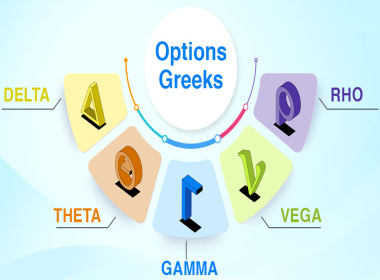
7. Gamma vs. Other Greeks
To place Gamma in context:
- Delta: First derivative of option premium.
- Gamma: Second derivative, showing Delta’s sensitivity.
- Theta: Time decay of options.
- Vega: Sensitivity to volatility.
Together, these Greeks form the backbone of options pricing and risk analysis.
8. Gamma Spikes
Gamma can spike during periods of high speculation or near expiry. When traders aggressively buy or sell options, Gamma values rise, making positions highly sensitive to small price changes. This often leads to sharp intraday moves in option premiums.
9. Hedging Gamma
Professional traders use strategies like:
- Delta-Gamma hedging: Adjusting both Delta and Gamma exposures.
- Calendar spreads: Using different expiries to balance Gamma.
- Butterfly spreads: Benefiting from Gamma behavior around strike prices.
Retail traders rarely hedge Gamma directly, but understanding it helps avoid risky positions.
10. Gamma in the Black-Scholes Model
Gamma is mathematically derived from the Black-Scholes formula. While the exact equation involves partial derivatives, the key takeaway is that Gamma depends on:
- Time to expiry
- Volatility
- Distance between strike and spot price
This explains why Gamma is highest for near-expiry, at-the-money options.
11. Real-World Trading Scenarios
Intraday traders: Benefit from Gamma when underlying moves sharply.
Option writers: Face Gamma risk, especially near expiry.
Hedgers: Use Gamma analysis to maintain balanced portfolios.
For example, a trader shorting at-the-money options before earnings announcements faces huge Gamma risk due to potential volatility spikes.
12. Gamma and Quantitative Trading
Quantitative traders, or “quants,” often build models that incorporate Gamma. By simulating thousands of scenarios, they estimate how portfolios behave under different market conditions. Gamma plays a central role in these risk simulations.
13. Key Takeaways
- Gamma measures the rate of change of Delta.
- It is highest for at-the-money options.
- Option buyers benefit from positive Gamma; sellers face risks from negative Gamma.
- Gamma spikes during high volatility and near expiry.
- Professional traders hedge Gamma risk; retail traders should at least understand it.
14. Conclusion
Gamma is not just a mathematical curiosity; it is a practical tool for traders. By understanding Gamma, you gain insight into how option premiums accelerate, how risks compound, and how strategies must adapt. Whether you are a beginner learning the Greeks or an advanced trader managing complex portfolios, Gamma deserves your attention.