Volatility and Normal Distribution in Trading: A Complete Guide
Introduction
Volatility is one of the most important concepts in financial markets. It measures how much the price of a stock, index, or asset fluctuates over time. Traders, investors, and analysts rely on volatility to estimate risk, set stop-loss levels, and design strategies. But volatility is not random chaos—it often follows a statistical pattern. One of the most powerful tools to understand this pattern is the normal distribution, also known as the bell curve.
This article explores volatility and normal distribution in depth, explaining how they connect, why they matter, and how traders can use them to make better decisions. We will cover the theory, practical applications, and examples from stock markets. By the end, you’ll have a clear understanding of how probability and statistics shape trading outcomes.
1. What is Volatility?
Definition: Volatility is the degree of variation in the price of a financial instrument over time.
Types of volatility:
- Historical volatility: Based on past price movements.
- Implied volatility: Derived from option prices, reflecting market expectations.
Why it matters: High volatility means higher risk but also higher potential reward. Low volatility suggests stability but limited opportunity.
Volatility is often expressed as a percentage and calculated using standard deviation of returns. For example, if a stock has a daily volatility of 1%, its price typically fluctuates ±1% around the mean return.
2. Random Walks and Market Behavior
Financial markets often behave like a random walk. This means that price changes are unpredictable in the short term. Just like dropping balls on a Galton board, each outcome is uncertain, but the overall distribution of outcomes follows a recognizable pattern.
Random walk analogy: Each ball dropped can go left or right, creating a path that cannot be controlled. Similarly, each day’s return in the stock market is uncertain.
Implication for traders: You cannot predict tomorrow’s exact return, but you can estimate the probability of returns falling within certain ranges.
3. The Normal Distribution Explained
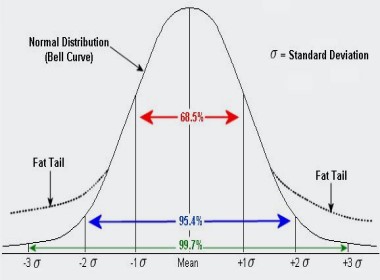
The normal distribution is a statistical curve shaped like a bell. It describes how data points cluster around a mean value.
Key properties:
- Symmetrical around the mean.
- Defined by two parameters:
- Mean (average): The central value.
- Standard deviation (SD): The measure of dispersion.
Probability ranges:
- Within 1 SD: ~68% of data.
- Within 2 SD: ~95% of data.
- Within 3 SD: ~99.7% of data.
This means that most returns fall within predictable ranges, while extreme events are rare but possible.
4. Volatility and Normal Distribution in Stock Returns
Daily returns of stocks and indices often approximate a normal distribution. For example:
- Nifty 50 index returns cluster around a small mean.
- Large-cap stocks like TCS or Cipla show similar bell-curve behavior.
- Small-cap stocks may have wider distributions but still follow the same principle.
By calculating the mean and standard deviation of returns, traders can estimate the probability of future price ranges.
5. Calculating Volatility Step by Step
- Collect data: Historical closing prices of the stock or index.
- Calculate daily returns:
Return = ln(Pt / Pt−1) where Pt is today’s price and Pt−1 is yesterday’s price. - Find mean return: Average of daily returns.
- Compute standard deviation: Measure of dispersion around the mean.
- Annualize volatility: Multiply daily volatility by 252 (trading days in a year).
6. Practical Example: Nifty Index
Suppose:
- Daily mean return = 0.04%
- Daily volatility = 1.046%
- Current price = 8337
Annualized values:
- Mean = 9.66%
- Volatility = 16.61%
Range estimation:
- 1 SD (68% confidence): Between 7777 and 10841.
- 2 SD (95% confidence): Between 6587 and 12800.
- 3 SD (99.7% confidence): Extreme ranges, rare events.
This shows how probability helps traders anticipate possible price ranges.
7. Black Swan Events
Not all outcomes fit neatly into the bell curve. Rare, extreme events—called Black Swans—can occur. Examples include:
- 1929 Great Depression
- 1987 Black Monday crash
- 2008 Global Financial Crisis
- 2020 COVID-19 market crash
These events lie outside the 3 SD range but have catastrophic impacts. Traders must prepare for such possibilities through risk management.
8. Applications in Trading
a) Options Trading
- Volatility determines option premiums.
- Normal distribution helps select strike prices.
- Traders can estimate probability of option expiring in-the-money.
b) Risk Management
- Stop-loss levels can be set using volatility ranges.
- Portfolio diversification reduces exposure to extreme outcomes.
c) Strategy Design
- Mean reversion strategies rely on prices returning to average.
- Breakout strategies exploit moves beyond expected ranges.
9. Limitations of Normal Distribution
- Markets are not perfectly normal; they exhibit fat tails (more extreme events than predicted).
- Volatility clustering: High volatility periods tend to follow each other.
- Behavioral factors: Human emotions can distort probabilities.
Despite these limitations, normal distribution remains a powerful approximation tool.
10. Conclusion
Volatility and normal distribution provide a statistical foundation for understanding market behavior. While daily returns are unpredictable, their overall distribution follows a bell curve. By calculating mean and standard deviation, traders can estimate price ranges with confidence. However, they must remain aware of rare Black Swan events that can disrupt markets.
Using these concepts, traders can design better strategies, manage risk effectively, and approach markets with a quantitative mindset.