Introduction
Price charts often steal the spotlight in trading discussions, but volume is the hidden force that validates every move. Without volume, price action is incomplete. Volume analysis helps traders understand whether a trend is genuine, whether institutional investors are involved, and whether a breakout or breakdown is sustainable. This article explores volume in detail, offering practical insights for intraday traders, swing traders, and long-term investors.
Section 1: What Is Volume?
Volume represents the total number of shares traded during a specific period. Every transaction requires both a buyer and a seller, so volume reflects completed trades rather than separate buy/sell counts. For example, if 100 shares are bought and sold, the volume is 100—not 200.
Volume is cumulative throughout the day. At the end of a trading session, the reported figure shows the total activity across all trades.
Section 2: Why Volume Matters
Volume is a measure of market participation.
High volume = strong conviction, often linked to institutional activity.
Low volume = weak conviction, usually retail-driven.
Volume confirms whether a price move is sustainable or likely to reverse.
In short, price tells you what is happening, while volume tells you how strong it is.
Section 3: Price–Volume Relationship
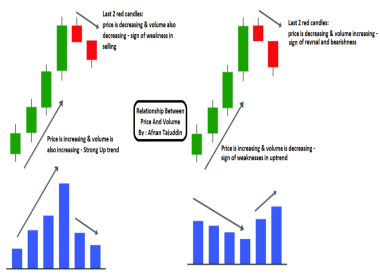
The interaction between price and volume generates powerful signals:
| Price Movement | Volume Movement | Market Expectation |
|---|---|---|
| Price ↑ | Volume ↑ | Bullish (smart money buying) |
| Price ↑ | Volume ↓ | Caution (possible bull trap) |
| Price ↓ | Volume ↑ | Bearish (smart money selling) |
| Price ↓ | Volume ↓ | Caution (possible bear trap) |
This framework helps traders avoid false signals and align with institutional flows.
Section 4: Measuring Volume Strength
Traders often compare today’s volume with the 10-day moving average:
High volume: Today’s volume > 10-day average.
Low volume: Today’s volume < 10-day average.
Average volume: Today’s volume ≈ 10-day average.
This simple technique highlights unusual activity and potential institutional involvement.
Section 5: Institutional vs. Retail Activity
Institutional investors (mutual funds, FIIs, DIIs) trade in large blocks, creating visible spikes in volume. Retail traders, by contrast, trade in smaller lots.
Smart money buying: Price rises with strong volume.
Smart money selling: Price falls with strong volume.
Retail traps: Price moves with weak volume, often reversing quickly.
Following smart money is a cornerstone of successful trading.
Section 6: Volume in Candlestick Patterns
Volume adds credibility to candlestick setups:
Bullish engulfing near support + high volume = strong buy signal.
Bearish engulfing near resistance + high volume = strong sell signal.
Morning star or evening star patterns are more reliable when supported by above-average volume.
Section 7: Volume in Breakouts and Breakdowns
Breakout confirmation: A price breaking resistance with high volume is more reliable.
Breakdown confirmation: A price breaking support with high volume signals strong bearishness.
False breakouts: Breaks with low volume often fail, trapping traders.
Section 8: Volume in Intraday Trading
Intraday traders rely heavily on volume:
Compare current intraday volume with the previous day’s levels.
Monitor spikes during key times (opening, mid-session, closing).
Use volume with VWAP (Volume Weighted Average Price) for precision.
Section 9: Volume in Long-Term Investing
For investors, volume highlights accumulation and distribution phases:
Accumulation: Institutions quietly buy at support levels, reflected in steady volume increases.
Distribution: Institutions sell gradually at resistance, often before a major decline.
Section 10: Misinterpretations to Avoid
Color of volume bars: Green or red bars are less important than actual size.
Equal buy/sell quantities: Every trade has both a buyer and seller; volume reflects transactions, not imbalance.
High volume ≠ guaranteed trend: Always confirm with price action.
Section 11: Advanced Volume Techniques
Relative Volume (RVOL): Compares current volume to historical averages.
On-Balance Volume (OBV): Adds volume on up days, subtracts on down days.
Volume trendlines: Drawing trendlines on volume bars to spot breakouts in participation.
Section 12: Volume Traps
Bull trap: Price rises on weak volume, luring buyers before reversing.
Bear trap: Price falls on weak volume, luring sellers before bouncing back.
Avoiding traps requires checking whether volume supports the move.
Section 13: Checklist for Volume-Based Trading
Before entering a trade:
- Identify candlestick pattern.
- Confirm support/resistance levels.
- Compare volume with 10-day average.
- Ensure risk-to-reward ratio is favorable.
- Watch for institutional activity.
Conclusion
Volume analysis is a cornerstone of technical trading. It validates price action, reveals institutional participation, and helps traders avoid traps. By combining volume with candlestick patterns, support/resistance, and moving averages, traders can build a robust strategy for both intraday and long-term success.